Blog20 min read
2 Weeks in Thailand: Bangkok Is a Hub, Not a Waypoint
A fourteen day Thailand itinerary built around the domestic flight map, why the straight north to south overland line costs days, and which coast your dates allow.
By Dom


Most two week Thailand plans are drawn as a line. Bangkok at the top, Chiang Mai above it, the islands at the bottom, and an arrow running down the page.
The country's transport map is not a line. It is a wheel, and Bangkok is the hub. Thailand's railway radiates from the capital in four directions and there is no rail link joining the Northern Line to the Southern Line that avoids it. The flight network is shaped the same way: the routes with dozens of daily departures all touch Bangkok, and the ones that skip it are single carrier services running once or twice a day.
That is not a detail. It decides how many of your fourteen days you spend moving, and the answer is usually two more than anyone planned for.
This is a fourteen day itinerary built on the shape of the map rather than the shape of the page.
The map you are actually planning against
Start with the railway, because it is the clearest illustration.
The State Railway of Thailand runs a radial network out of Bangkok. The Northern Line covers 751 km to Chiang Mai. The Southern Line runs from Bangkok down the peninsula towards the Malaysian border. They meet in Bangkok and nowhere else. About 70 per cent of the roughly 4,800 km network is still single track even after a decade of double-tracking work, which is why journey times look the way they do.
So the overland version of "Chiang Mai to the islands" is this:
| Leg | Scheduled time |
|---|---|
| Chiang Mai to Bangkok, overnight sleeper | about 12 hours 35 minutes |
| Bangkok to Surat Thani, fastest service | 8 hours 50 minutes, commonly 9 to 11 |
| Surat Thani station to Donsak pier | road transfer, the station sits about 15 km outside the city |
| Donsak to Nathon, Koh Samui | about 1 hour 30 minutes by ferry |
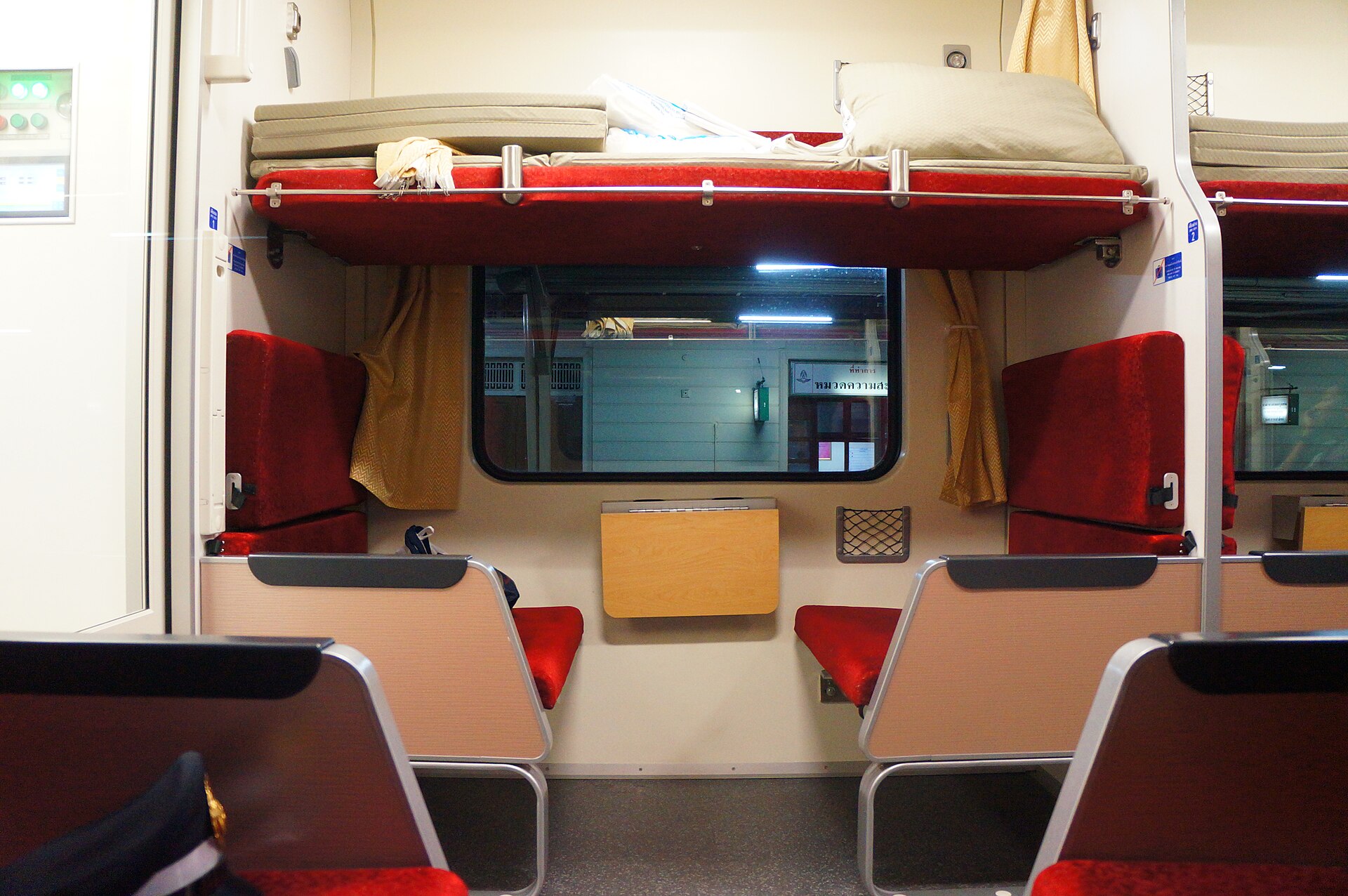
Two of your fourteen nights go on a train, you arrive on the island some time on the third day, and you have seen the inside of Krung Thep Aphiwat Central Terminal twice. The northbound sleeper is a genuinely good ride on the newer Chinese-built stock. Doing it in both directions inside a fortnight is not romance, it is arithmetic going wrong.

Where the flights actually go
The air network has the same shape, and the frequency numbers make the point better than any argument.
| Route | Weekly departures | Operating carriers | Flight time |
|---|---|---|---|
| Bangkok Suvarnabhumi to Chiang Mai | 98 | 4 | about 1h 20m |
| Bangkok Don Mueang to Chiang Mai | 152 | 3 | about 1h 15m |
| Bangkok Suvarnabhumi to Phuket | 94 | 4 | about 1h 30m |
| Bangkok Don Mueang to Phuket | 131 | 3 | about 1h 30m |
| Bangkok Suvarnabhumi to Koh Samui | 176 | 1 (Bangkok Airways) | about 1h 05m |
| Chiang Mai to Phuket | 17 | 3 | about 2h 05m |
| Chiang Mai to Koh Samui | 10 to 14 | 1 (Bangkok Airways) | about 1h 45m |
| Chiang Mai to Krabi | 7 to 19, sources disagree | 1 to 2 | about 2h |
| Koh Samui to Phuket | 53 | 1 (Bangkok Airways) | about 1h |
Bangkok to Chiang Mai is roughly 250 flights a week across the two airports, about 36 a day. Chiang Mai to Koh Samui is two departures a day on one airline's aircraft. Published weekly counts for that route disagree, from 10 up to 31, and the higher figures are codeshares sold by other airlines on the same Bangkok Airways flights. Either way, you are choosing between two departures, not thirty.
Two consequences follow.
The north to south direct flight is worth booking, and worth booking early. Chiang Mai straight to Phuket, Krabi or Koh Samui removes an entire Bangkok pass from the middle of your trip. On a fourteen day plan that is most of a usable day.
If it does not exist on your date, do not fight it. Route through Bangkok deliberately and give the connection real time, rather than buying two separate cheap tickets three hours apart and discovering the problem below.
The Bangkok trap: two airports, not one
Bangkok has two commercial airports and they are not interchangeable. Suvarnabhumi (BKK) handles the full service carriers and most long haul. Don Mueang (DMK) handles most of the low cost domestic flying, which is why the cheapest Chiang Mai fare is so often a Don Mueang one.
Airports of Thailand runs a free shuttle bus between them. It is only for passengers holding a boarding pass for a connecting flight between the two airports, checked against a passport at the door, and it runs from 05:00 to midnight. The target running time is 50 minutes and the realistic allowance is an hour and a half, because it is Bangkok traffic.
If you booked the two legs separately you are not a transfer passenger. You are a person with luggage crossing a city of eleven million on a public bus or in a taxi, and you have to re-check your bags at the far end. Budget four hours between separately booked flights at different Bangkok airports, or pay for the single ticket that keeps you at one.
Coming in from the city, the Airport Rail Link runs Suvarnabhumi to Phaya Thai in about 26 minutes for 45 baht, which is the cheapest useful thing in Bangkok transport.
Two coasts, two monsoons, one choice
Thailand's south has two coasts with opposite rain calendars, and choosing between them is not a preference, it is a date lookup.
| Place | Annual rainfall | Wettest months |
|---|---|---|
| Phuket, Andaman coast | about 2,210 mm | September about 325 mm, October about 315 mm |
| Koh Samui, Gulf coast | about 1,995 mm | November about 445 mm, October about 295 mm |
| Bangkok | about 1,650 mm | September about 335 mm, October about 290 mm |
| Chiang Mai | about 1,125 mm | August about 225 mm, September about 200 mm |
The Andaman coast takes the southwest monsoon straight off the sea from roughly May to October. The Gulf coast is sheltered then, and takes the retreating monsoon from October to December instead. November is the worst month on Samui and one of the better ones on Phuket.
So: pick the coast your dates favour and go there. Doing both inside fourteen days means a Samui to Phuket flight, which does exist at about eight departures a day on Bangkok Airways, plus two more hotel changes and two more airport mornings. You will have visited two beaches instead of one and seen less of each.
One more southern date to know. Maya Bay, on Phi Phi Leh, closes to visitors from 1 August to 30 September, along with Loh Samah and Lo Kor bays, under a Department of National Parks conservation order that has been reissued in successive years. Boat tours to the Phi Phi islands still run in that window; they just cannot enter the bay.
The north's date problem is not rain
Chiang Mai's rainfall is the lowest of the four places above, and its worst season has nothing to do with rain.
From roughly February to April, agricultural and forest burning across northern Thailand and the wider region fills the valley with smoke. NASA's Earth Observatory reports that fire activity typically peaks in March and fades by May as the rains return, and that around 70 per cent of Chiang Mai's fine particulate pollution in April comes from biomass burning. On 22 April 2026, ground sensors recorded unhealthy and very unhealthy PM2.5 levels across Chiang Mai and the surrounding region, and the ASEAN Specialised Meteorological Centre had raised its haze alert to the highest level on 27 March that year.
This is the one thing in Thailand planning that is genuinely worth reshaping a trip around. March in Chiang Mai can mean a week of grey air, no mountain views and a sore throat. If your dates are locked to February, March or April and someone in the party has asthma, cut the north short and give the days to the coast.
The northern high season, roughly November to February, is cool, clear and comfortable, which is why the trip below is written for it.
The fourteen days
This assumes an open jaw booking if you can get one, and a Bangkok return if you cannot. Nights are what matter, so they are counted rather than days.
Days 1 to 3: Bangkok, three nights
Land, and give the first afternoon to nothing more ambitious than a river boat and dinner.
The old royal quarter is a single morning if you are organised, and the ticket prices are worth knowing before you queue. The Grand Palace charges foreign visitors 500 baht, opens 08:30 to 16:30 and stops selling tickets at 15:30, so an 11:00 arrival is a bad plan on a hot day. The dress code is enforced at the gate: shoulders and knees covered, for everyone. Wat Pho, five minutes' walk away, is 300 baht at the gate and holds the reclining Buddha. Wat Arun, across the river by cross-river ferry, is widely published at 200 baht for the temple's inner terraces, with the grounds free.
Do those three in one morning, in that order, and be out before the worst of the heat. Give the afternoons to Chinatown, the Jim Thompson House, a canal boat in Thonburi, and the food, which is the actual reason to spend three nights here rather than one.
Day 4: Ayutthaya
The former capital is about an hour and a half north of Bangkok by train or road and is a comfortable day trip. There is no charge to enter the historical park itself; the major individual temples charge 50 baht each for foreign visitors, and a combined ticket covering six of the main sites is widely quoted at 220 baht valid for 30 days, though not every source lists it. Buy at the first gate you reach and ask.
Hire a bicycle or a tuk-tuk rather than walking between temples. The sites are further apart than the map suggests and the shade is limited.
Day 5: Fly to Chiang Mai
Take an early flight and you get most of the day. This is the easiest leg in the country: about 36 departures a day across the two Bangkok airports, an hour and a bit in the air, and enough competition that the fare is rarely the problem.
If you would rather take the overnight sleeper, take it in this direction. Train 9 leaves Krung Thep Aphiwat at 18:40 and reaches Chiang Mai at 07:15, about 12 hours 35 minutes, on the newer stock with proper berths and a dining car. It costs you a night rather than a day, which is the version of that trade worth making. Long distance reservations open 90 days ahead, a window SRT cut from six months in April 2026.
Days 5 to 8: Chiang Mai, four nights
Four nights is right, and it is the part most itineraries underweight.
The old city inside the moat is walkable and full of temples that cost nothing or nearly nothing to enter. Wat Phra That Doi Suthep sits up the mountain west of the city and is the one to make an effort for, ideally early. The Sunday Walking Street market is the good one if your dates line up.
Beyond the city, pick one of these rather than all three:
- Chiang Rai and the White Temple, about 3 hours 20 minutes each way with Green Bus, 13 departures a day across VIP and Express classes, from around 290 baht in Express up to about 400 baht for VIP. Doable in a long day, better with an overnight.
- Doi Inthanon National Park, Thailand's highest point, an easy day with a driver.
- An elephant sanctuary. Choose one with no riding and no bathing-with-tourists programme, and read what the operator actually says about how the animals spend the rest of the day. This is the single item on a Thailand itinerary where the cheap option and the ethical one are rarely the same.
Pai gets suggested constantly and does not fit. It is a winding three hour minibus each way, and it wants three nights to be worth the road.
Day 9: Fly south
This is the day the whole plan turns on.
If a direct Chiang Mai to south flight exists on your date, take it. Chiang Mai to Phuket is about 2 hours 5 minutes with roughly two departures a day across three airlines. Chiang Mai to Koh Samui is about 1 hour 45 minutes, two departures a day, Bangkok Airways only. Chiang Mai to Krabi runs once or twice a day.
If it does not, route through Bangkok on one ticket. Not two. See the two-airport section above.
Either way, this is a travel day. Do not schedule an activity at the far end.
Days 9 to 13: One coast, five nights
If your dates are November to April, take the Andaman side. Base in Krabi or Ao Nang rather than Phuket town if you want limestone and quiet water; base in Phuket if you want the flight options and the restaurants. Railay is reachable only by longtail boat, which is part of why it is worth going. Ferries from Phuket's Rassada pier to Phi Phi take about two hours, with speedboats doing it in about one. Note the national park fees, which are charged separately from your boat ticket: 400 baht for a foreign adult at Mu Ko Phi Phi, 500 baht at Mu Ko Similan.
If your dates are May to September, take the Gulf side. Koh Samui for comfort and flights, Koh Phangan for a quieter version of the same island, Koh Tao if diving is the point. Mu Ko Ang Thong marine park is 300 baht for a foreign adult.
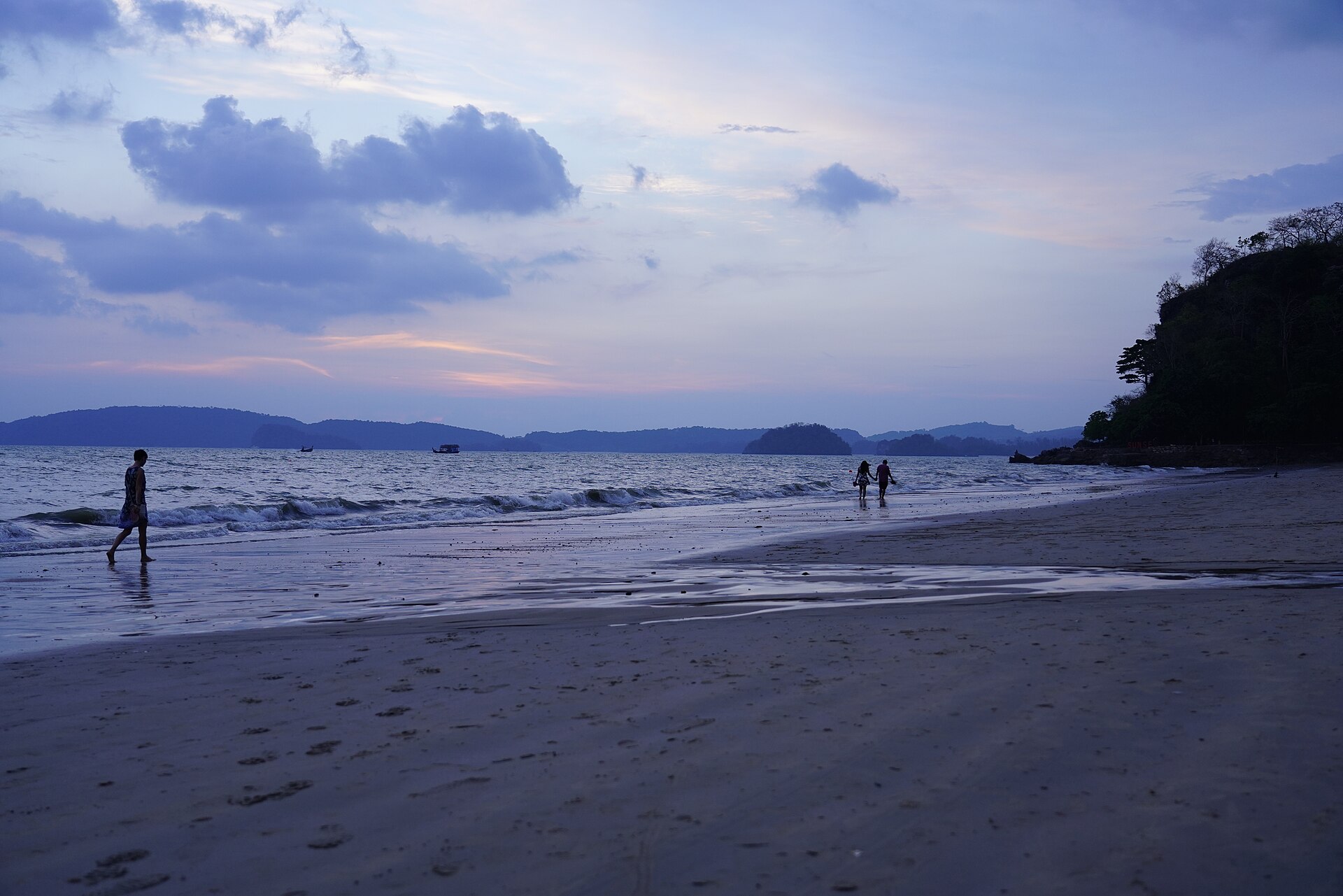
Five nights on one coast buys two full beach days, one boat day, one inland or diving day, and one day where the weather is bad and it does not matter. That last one is the reason for five rather than three.

Day 14: Home
Fly the south to Bangkok leg with real margin, because it is the leg that strands people. Phuket to Bangkok runs about 40 times a day across the two airports, Samui to Bangkok about 25 times a day on Bangkok Airways. Frequency is your insurance, but only if you have left room to use it.
If you booked a Bangkok return rather than an open jaw, that final internal flight is the third time you have passed through the capital. It is also the one that is hardest to remove, which is why the open jaw is worth pricing first.
What needs booking ahead, and what does not
Thailand is mostly a turn-up country. The exceptions are short and specific.
Book the Chiang Mai to south flight as soon as your dates are fixed. Two departures a day is not a rolling timetable. This is the single booking with the largest effect on your itinerary.
Book long distance train berths early if you want the sleeper. Reservations open 90 days out, a window SRT cut from six months in April 2026, and the good berths on trains 9 and 10 go.
Book around Songkran or accept what it does. Thai New Year is fixed on 13 April, with 13 to 15 April as national holidays and the period sometimes extended when it falls near a weekend. Most of Bangkok travels home, so trains, buses and domestic flights either side fill early. A wonderful thing to be in the middle of, and an impossible week to improvise in.
Everything else, including every temple ticket named in this post, you buy at the door in cash.
Paperwork, fees and one that keeps being postponed
The digital arrival card is mandatory and free. Since 1 May 2025, every foreign national entering Thailand by air, land or sea must complete the Thailand Digital Arrival Card online before arrival, at tdac.immigration.go.th. It replaced the paper TM6. UK government guidance says travellers can register within three days before they arrive, so do it a day or two before you fly. It is free, and it is single entry, so a border hop means a new one.
Visa exemption, with a caveat. British citizens and nationals of a long list of other countries can currently enter visa-free for 60 days for tourism, extendable in country by a further 30. A cut to 30 days was approved by Thailand's cabinet in May 2026, and at the end of August 2026 the signed notices were awaiting publication in the Royal Gazette, so it could take effect at short notice. UK government advice still stated 60 days as this was written. Check your own government's page in the month you travel rather than trusting a guide, including this one.
Passport rules. At least six months validity beyond your arrival date and at least one blank page.
The 300 baht arrival fee still is not being charged. Thailand has approved a travel fee of 300 baht for air arrivals and 150 baht by land or sea, and has postponed it repeatedly. As of the most recent reporting it was pushed to the second or third quarter of 2026 and still awaited cabinet sign-off and a collection system. Budget for it, do not expect it.
Key Takeaways
| Point | Details |
|---|---|
| The transport map is a wheel, not a line | Thailand's railway radiates from Bangkok and there is no rail link between the Northern and Southern lines that avoids it. The Northern Line alone is 751 km. |
| Overland north to south costs two nights | Chiang Mai to Bangkok is about 12h 35m, Bangkok to Surat Thani 8h 50m at best, plus a road transfer and a 1h 30m ferry. |
| The Bangkok routes are dense, the bypasses are thin | About 250 weekly flights Bangkok to Chiang Mai across two airports, against 10 to 14 Chiang Mai to Koh Samui on one carrier. |
| Book the Chiang Mai to south flight first | Two departures a day. It removes a whole Bangkok pass from the middle of the trip. |
| Suvarnabhumi and Don Mueang are different airports | The free AOT shuttle is for connecting passengers only, targets 50 minutes and realistically wants 90. Two separate tickets means four hours. |
| The two coasts have opposite rain calendars | Phuket peaks around 325 mm in September; Samui peaks around 445 mm in November. Pick one coast, not both. |
| February to April is smoke season in the north | NASA reports fire activity peaking in March, with about 70 per cent of Chiang Mai's April PM2.5 coming from biomass burning. |
| Bangkok's three big tickets | Grand Palace 500 baht, closing ticket sales at 15:30. Wat Pho 300 baht. Wat Arun widely published at 200 baht. |
| Maya Bay shuts 1 August to 30 September | Under a Department of National Parks order reissued annually. Phi Phi tours still run, they just cannot enter. |
| The digital arrival card is compulsory and free | Required for every foreign arrival since 1 May 2025, at tdac.immigration.go.th, single entry only. |
Where this plan breaks
It breaks first if you try to keep both coasts. Samui to Phuket is a real flight, about an hour, roughly eight a day. It is also a fourth hotel change, a fifth airport morning and the fastest way to turn five relaxed nights into two rushed pairs. If both coasts genuinely matter, drop Ayutthaya and one Chiang Mai night, and even then it is tight.
It breaks if your Chiang Mai to south flight cancels. One or two departures a day means no same-day recovery. The Bangkok routing is the fallback and it is a full day, so anything booked and prepaid on the coast for that evening is at risk. This is an argument for arriving on the coast a night earlier than your first prepaid commitment, not for travel insurance alone.
It breaks in the north between February and April. Not because of rain, because of smoke. There is no local plan B for a valley full of particulates. The only real mitigation is fewer nights in Chiang Mai and more on the coast, decided before you book, not after you land.
It breaks if you add Pai, Sukhothai and Kanchanaburi. Each is genuinely good and each is a two-night commitment with a slow road at both ends. Two weeks holds Bangkok, one northern base and one coast, plus one day trip. A third region has to displace something, and what it usually displaces is the rest day that made the trip pleasant.
How Planytera handles a trip like this
Planytera is an AI trip planner built by a solo developer, available on iOS, Android and the web. You describe the trip and it builds a day-by-day itinerary, ready in moments. On a country shaped like this one, three things do most of the work.
Multi-stop pacing across four bases. Bangkok, Ayutthaya as a day out, Chiang Mai and one coast is four moves in fourteen days, and the moves are what decide whether the plan holds. Setting the pace once and letting the days arrange themselves around the transfer days is a different job from writing four separate city plans and hoping the joins line up.
Re-pacing without starting over. This is a trip where one decision, which coast, changes the back half entirely, and where a single cancelled flight can move everything. Shifting a night from Chiang Mai to Krabi, or pushing the southern arrival back a day, leaves the rest of the plan consistent instead of needing a rebuild from day one.
Offline access. Coverage is good in Bangkok and Chiang Mai and patchy on the boats, in the national parks and on the mountain roads. Saved trips keep the itinerary, maps and notes readable with no signal, which matters most on exactly the days you are moving.
Frequently asked questions
Is two weeks enough for Thailand?
For Bangkok, one northern base and one southern coast, at a pace that includes rest, yes. It is not enough for both coasts plus the north, and it is not enough to add Pai, Sukhothai or Kanchanaburi without cutting something. The limiting factor is not distance, it is that Thailand's transport map routes almost everything through Bangkok, so each region change is most of a day.
Should I take the overnight train from Bangkok to Chiang Mai or fly?
Take the train once, northbound, if the idea appeals. Train 9 leaves Krung Thep Aphiwat at 18:40 and arrives in Chiang Mai at 07:15, about 12 hours 35 minutes, on modern sleeper stock. It costs a night rather than a day. Do not take it in both directions inside a fortnight: the flight is about an hour and a quarter, with roughly 36 departures a day across Bangkok's two airports.
Can I fly from Chiang Mai to the islands without going through Bangkok?
Yes, but thinly. Chiang Mai to Phuket runs about 17 times a week across three airlines, roughly two a day. Chiang Mai to Koh Samui is Bangkok Airways only, about two departures a day, with published weekly counts ranging from 10 to 31 depending on whether codeshares are counted. Chiang Mai to Krabi is once or twice a day, with published counts disagreeing. Book it as soon as your dates are fixed, because there is no later flight to move to.
Which is better, Phuket or Koh Samui?
Whichever one your dates favour. They sit on coasts with opposite rain calendars: Phuket's wettest months are September and October, at around 325 mm and 315 mm, while Koh Samui's are November at around 445 mm and October at around 295 mm. Phuket has more flights and more places to eat, Samui is smaller and easier to get around, and neither is worth visiting in its own monsoon when the other is dry.
When is the worst time to visit Chiang Mai?
February to April, and the reason is air quality rather than weather. NASA's Earth Observatory reports fire activity across northern Thailand peaking in March and fading by May, with roughly 70 per cent of Chiang Mai's April fine particulate pollution coming from biomass burning. In late April 2026, ground sensors recorded unhealthy to very unhealthy PM2.5 across the region. November to February is the north at its best.
Do I need a visa for Thailand, and what is the digital arrival card?
Nationals of a long list of countries, including the United Kingdom, can currently enter visa-free for 60 days for tourism, extendable by 30 days in country. A reduction to 30 days was approved by Thailand's cabinet in May 2026 and was awaiting publication in the Royal Gazette at the end of August 2026, so check your own government's guidance in the month you travel. Separately, and regardless of visa status, every foreign arrival since 1 May 2025 must submit the free Thailand Digital Arrival Card online at tdac.immigration.go.th before entering.
Useful sources and further reading
- UK government travel advice for Thailand, the 60 day visa exemption, passport validity and the digital arrival card requirement.
- Where the 60 to 30 day visa exemption cut stands, the May 2026 cabinet approval and the pending Royal Gazette publication.
- Thailand Digital Arrival Card, the official immigration portal, and the Tourism Authority of Thailand's TDAC guideline.
- The Grand Palace official site, the 500 baht admission and the 08:30 to 16:30 opening with tickets to 15:30.
- Wat Pho official booking site, the 300 baht foreign admission.
- Rail transport in Thailand, the radial line structure, the 751 km Northern Line and the single-track share.
- Seat 61 on Thai trains, train 9 and 10 timings and fares.
- SRT shortens the booking window to 90 days, the April 2026 change from 180 days.
- FlightConnections, the route-by-route weekly frequencies, operating carriers and flight times quoted throughout.
- Climates to Travel: Thailand, the monthly rainfall figures for Bangkok, Chiang Mai, Phuket and Koh Samui.
- NASA Earth Observatory: Smoke Shrouds Northern Thailand, the burning season timing and the April PM2.5 attribution.
- Maya Bay's annual closure, the Department of National Parks order covering 1 August to 30 September.
- Thailand's travel fee postponed again, the 300 baht air arrival fee and its current status.
Recommended
More from the Planytera blog.