Blog19 min read
7 Days in Jordan: Pass Maths, and Petra in Two Days
A seven day Jordan plan built on the official numbers: what the Jordan Pass actually saves, when it is the wrong purchase, and why Petra needs two days.
By Dom

Jordan is unusual in that the government has already done the pricing arithmetic for you and published the answer. The Jordan Pass bundles your tourist visa with entry to more than forty sites, and it is sold by the Ministry of Tourism and Antiquities itself.
Because of that, most Jordan itineraries treat the pass as settled and move on. That is a mistake in both directions. There are travellers for whom the pass is close to break-even and nobody tells them, and there is a five dinar decision inside it that quietly determines whether the trip is any good.
That five dinars is the gap between the one day Petra tier and the two day Petra tier. It is the cheapest and most consequential choice on the whole trip, because Petra is a national park with twenty-five published walking trails in it, and a one day ticket buys you the first stretch of one of them.
The Jordan Pass, and the only number that matters
The pass comes in three tiers, identical except for how many days of Petra they include. All three waive the tourist visa fee and cover entry to more than forty attractions.
The numbers they replace: a single entry tourist visa costs 40 JD, and Petra's own official prices, for a visitor staying overnight in Jordan, are 50 JD for one day, 55 JD for two and 60 JD for three. Line them up.
| Tier | Petra | Buying separately | Pass | Difference |
|---|---|---|---|---|
| Jordan Wanderer | 1 day | 40 + 50 = 90 JD | 70 JD | 20 JD |
| Jordan Explorer | 2 consecutive days | 40 + 55 = 95 JD | 75 JD | 20 JD |
| Jordan Expert | 3 consecutive days | 40 + 60 = 100 JD | 80 JD | 20 JD |
Two things fall out of that table, and neither is what people usually take away.
The pass saves exactly 20 JD at every tier, before you enter a single other site. Everything else is on top. The Jordan Tourism Board's fee schedule puts Jerash at 10 JD for foreigners, the Amman Citadel at 3, the Roman Theatre at 2, Wadi Rum at 5, Umm Qais at 5, Ajloun Castle at 3 and Karak Castle at 2. On a normal seven day route you will clear 25 to 30 JD of those without trying.
Upgrading a Petra day costs 5 JD. Wanderer to Explorer is five dinars for a second full day inside the largest archaeological site in the country. There is no other five dinars on this trip that buys anything comparable.
When the Jordan Pass is the wrong purchase
The pass is the default answer, not the universal one. Four cases break it.
You arrive and leave through Aqaba. Aqaba is a special economic zone and the visa is free for travellers arriving directly at King Hussein International Airport there, at the Aqaba seaport, or at the southern Wadi Araba crossing, provided you leave through the same point. If the 40 JD was never going to be charged, the pass loses most of its margin. The Explorer at 75 JD is then competing with Petra at 55 plus Jerash at 10 plus Wadi Rum at 5 plus the Citadel at 3, which is 73. It tips in the pass's favour once you add a few more sites, and it tips back if your trip is Petra and Wadi Rum only.
You are crossing at Wadi Araba and coming back the same way. The Jordan Pass FAQ says plainly that if you enter at Wadi Araba, stay a minimum of two nights and exit at the same border, your visa fees are waived without needing a pass at all. Their words, on their own site, about their own product.
You hold an Arab nationality, or you are in Jordan for one night. The pass is not sold to Arab nationality holders at all, and the waiver is conditional on a minimum stay: fall under it and you pay the 40 JD on the way out, leaving a site ticket you overpaid for.
One more limit, not about money: the pass gives single entry to each attraction. You cannot walk into Jerash twice on it. Petra is the only exception, and only on the Explorer or Expert tier, on consecutive days.
The minimum stay, where the official sources contradict each other
This is the single most confusing thing about the pass, and the confusion is not yours.
The Jordan Pass website says, in three separate places including its own FAQ, that the visa fee is waived if you buy before arrival and stay "a minimum of two nights (3 days)". The UK Foreign Office says the pass requires "at least 3 nights in Jordan", and a Jordanian Ministry of Foreign Affairs document describing the scheme says the same.
They cannot both be the current rule. Three nights satisfies everybody, two satisfies the pass operator and might not satisfy the officer at the desk, and a seven day trip makes the question moot. Plan for three.
Two conditions are not in dispute. Buy it before you arrive, because the waiver depends on it and there is no retroactive fix at the airport. And print it, because the pass site warns the QR code may not scan off a phone screen and asks you to show a printed copy to the passport officer and at every site. You will be asked for your passport at each site too, so carry it.
Petra needs two days, and here is the arithmetic
The case for two days is usually made emotionally. Here it is made with the site's own numbers.
Petra publishes twenty-five marked trails, from 1.5 km to 18.8 km. The one everybody walks, the Main Trail, is 3.9 km and rated easy: the Siq, the Treasury, the Street of Facades, the theatre and the colonnaded street, one way.
Almost nothing else is on that 3.9 km. The Monastery, Ad Deir, is a separate 2 km trail rated easy to moderate, with a harder 1.9 km alternative. Umm el Biyara at 2.6 km, Al Mataha at 2.9 km, Al Madras at 4.8 km, Jabal Harun at 7 km and Sabra at 7.9 km are all additional, as are the long ones: Al Khurma at 13.6 km and the Batha trails at 15 to 18.8 km.
Then add the opening hours, which are shorter than people assume. Petra's official times are 06:00 to 18:00 in the summer season, published as 2 March to 1 October, and 06:30 to 17:00 in winter, from 2 October to 1 March. That winter figure matters: a great many guides still print "06:00 to 16:00", and the official page says otherwise. The park also asks you to be out before sunset and does not permit overnight stays inside.
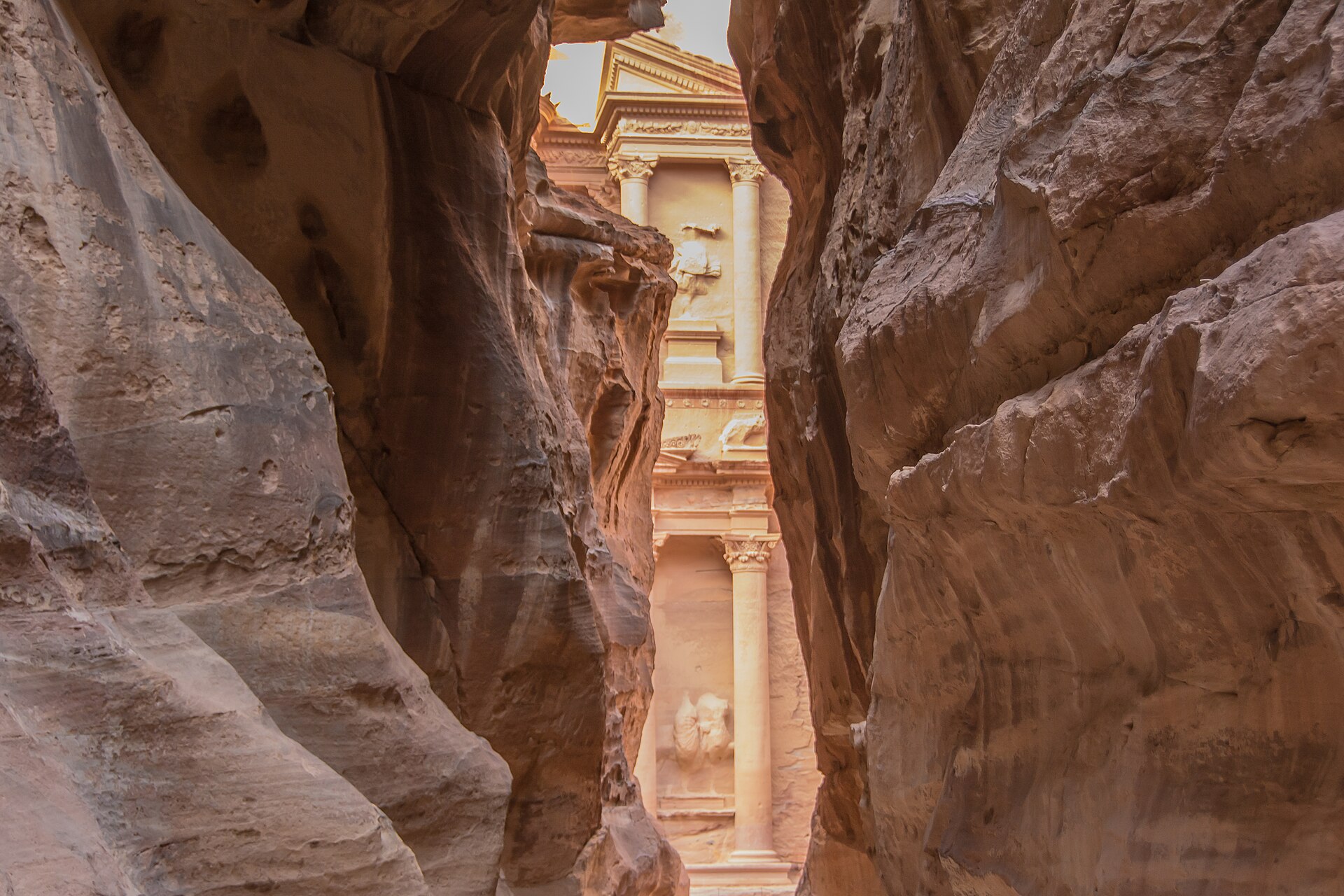

So a one day visit in winter is ten and a half hours of opening, of which the walk in and back out is 7.8 km on the Main Trail alone, in a site where the entrance is at one end and everything worth seeing is spread along the other. People do it. They do it by walking fast, past the things they came for, in the middle of the day when the light is flat and the Siq is full.
One more constraint the trail list implies: official guidance says to stick to the main trails unless you are with a guide. The back country of Petra is not a free wander.
What day one and day two should actually be
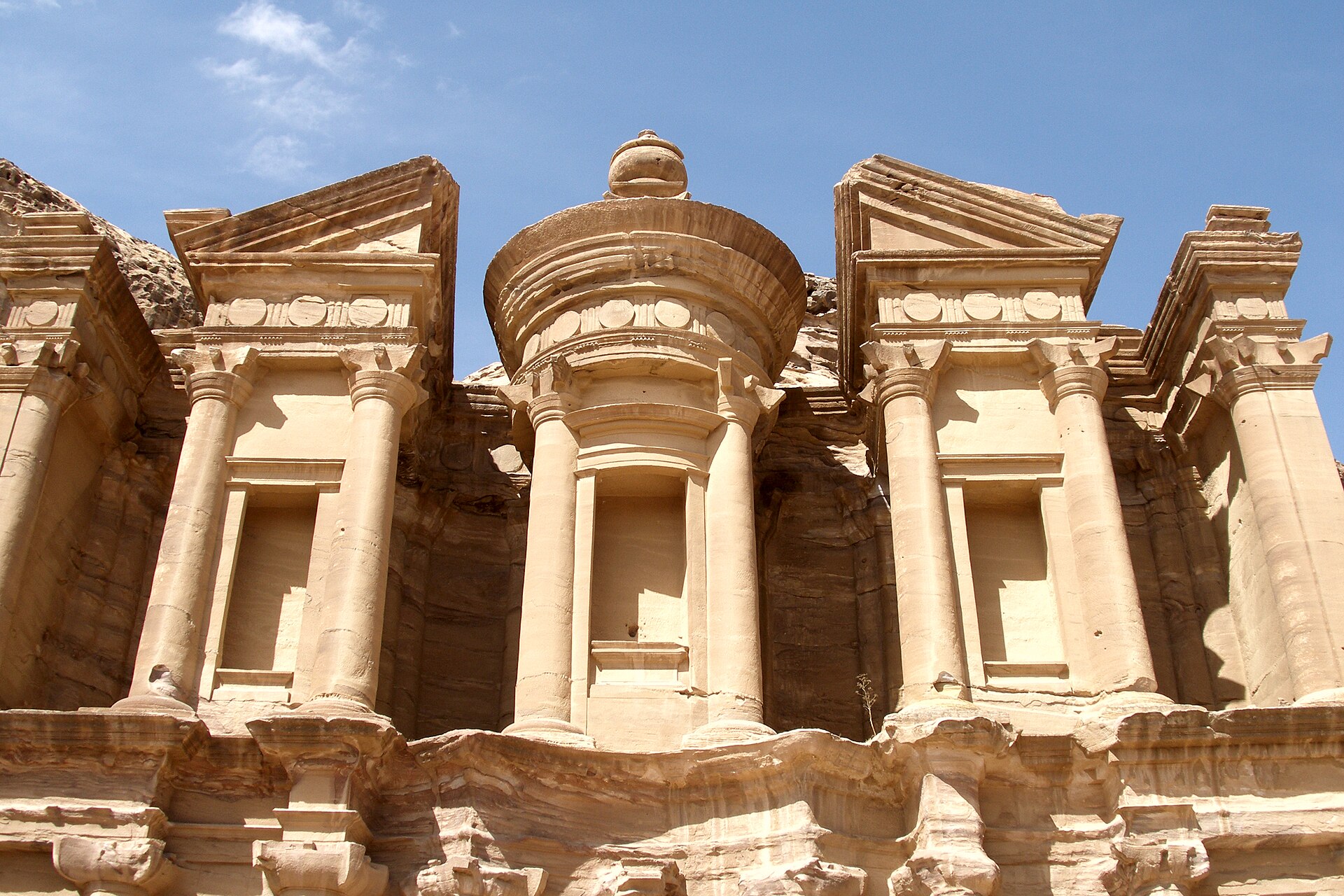
Day one is the Main Trail and the Monastery. Be at the gate at opening. The Siq is narrow and early is both cooler and the only time the walk is quiet. Treasury, Street of Facades, theatre, colonnaded street, then the climb to Ad Deir, then back down in the late afternoon. That is a full day and you will feel it.
Day two is the high ground and the parts with nobody on them. The Royal Tombs properly, rather than glanced at from below. The viewpoints above the Treasury. Al Mataha or Umm el Biyara. Or the back route in from Little Petra, which arrives at the Monastery from above instead of climbing to it and reverses the whole shape of the day. Little Petra runs shorter ticket office hours than the main site: 07:00 to 16:00 in summer, 07:00 to 14:00 in winter.

One practical trap: your Jordan Pass can only be scanned at Petra's Visitor Centre, not at the site's other gates. If your plan involves entering from Little Petra, sort the ticketing out at the Visitor Centre first.
Petra by Night is not the thing the internet describes
This is the clearest example on the trip of published travel information being years behind reality, and a lot of two day Petra plans are built on it.
What you will read almost everywhere: 17 JD, Monday, Wednesday and Thursday, a candlelit walk to the Treasury.
What is actually true. The price rose to 30 JD per person on 1 May 2025, announced by the operator, with under 10s free. The show was rebuilt around projection mapping onto the Treasury facade and moved to a Sunday to Thursday pattern, 20:30 to 22:30. Tickets are sold on site only, at the Visitor Centre kiosk, with no online booking. It is not included in any Jordan Pass tier, which the pass FAQ states outright.
And the part that changes plans: on 29 April 2026 the operator posted that operations are paused and not running on a fixed schedule, that the programme may be arranged depending on demand and how many visitors are staying in Wadi Musa, and that guests, hotels and agents should check directly before confirming anything.
Treat it as a possibility, not a fixture, and do not make it the reason you booked a second night.
Getting around: the times that decide the shape of the week
Jordan is small and the driving is straightforward, which lulls people into treating transfers as free.
| Leg | Time | Notes |
|---|---|---|
| Amman to Petra, Desert Highway | about 3 hours | The official figure from Petra's own authority |
| Amman to Petra, King's Highway | about 4 hours driving | Not a transfer, a day out. Karak and Shobak are on it |
| Amman to Petra, JETT coach | departs Abdali 06:30 | Returns from Petra at 17:00 |
| Amman to Petra, public minibus | departs 09:00 to 16:00 | Returns from Petra only between 06:00 and 13:00 |
| Aqaba to Petra, public bus | about 2 hours | |
| Petra to Wadi Rum | roughly 1h30 to 2h | Sources vary, most put the road distance in the mid 80s of kilometres |
| Wadi Rum to Aqaba | about an hour | Wadi Rum sits about 60 km east of Aqaba |
| Amman to Aqaba by air | about an hour | Queen Alia to King Hussein International |
Three of those deserve a note.
The minibus return window is the reason Petra is not a day trip from Amman. Public minibuses leave Petra between 06:00 and 13:00, with no evening service. The JETT coach does return, at 17:00, but combined with a 06:30 departure that gives you roughly six hours at a site whose Main Trail alone is 7.8 km round trip. Anyone selling Petra as a day trip from Amman is selling you the Treasury and a coach seat.
The King's Highway is a decision, not a route choice. Four hours of driving becomes a full day once you stop at Karak and Shobak, which is the entire point of taking it. Budget the day, or take the Desert Highway and keep it.
Wadi Rum is a five dinar entrance and an open-ended everything else. The 5 JD protected area fee is on the pass. The 4x4, the camp and the guide are not, and they are the real cost of the night.
The seven days
Six nights, three bases, one long transfer south. This routing flies into Amman and out of Aqaba, which removes the drive back north. If you reverse it and enter through Aqaba, recheck the pass maths first.
| Night | Base | The move that shapes the day |
|---|---|---|
| 1 | Amman | Arrival |
| 2 | Amman | Jerash and Ajloun, north and back |
| 3 | Petra (Wadi Musa) | South via Madaba and the King's Highway, or straight down |
| 4 | Petra | none |
| 5 | Petra | none |
| 6 | Wadi Rum | Petra to Wadi Rum, camp night |
| 7 | out via Aqaba | About an hour from Rum |
Day 1, Amman. Arrive, do very little. The Citadel and the Roman Theatre are both on the pass and about an hour each. Amman is a working capital rather than a sightseeing city, and one afternoon is the right allocation.
Day 2, Jerash. The best Roman city in the region that is not in Italy, roughly an hour north of Amman, and comfortably a half day with Ajloun Castle on the way back. Both are on the pass. The Jordan Tourism Board's table lists Jerash at 10 JD for foreigners while several current guides quote 12, which illustrates why the pass is convenient beyond the saving: you stop caring what the number is this month.
Day 3, go south. Two versions. Fast is the Desert Highway, about three hours, arriving in Wadi Musa with the afternoon intact. Slow is Madaba for the mosaic map, Mount Nebo, then the King's Highway through Karak, arriving at dusk. Take the slow one only if you accept losing the afternoon, and check what the pass covers first: the operative attractions list, the one with opening hours against each site, does not carry Mount Nebo, the Madaba Church of the Map or the Jordan Museum, even though a lower section of the same page mentions some of them. Carry cash for anything not on that list.
Days 4 and 5, Petra. Split as described above. Two gate openings, not one.
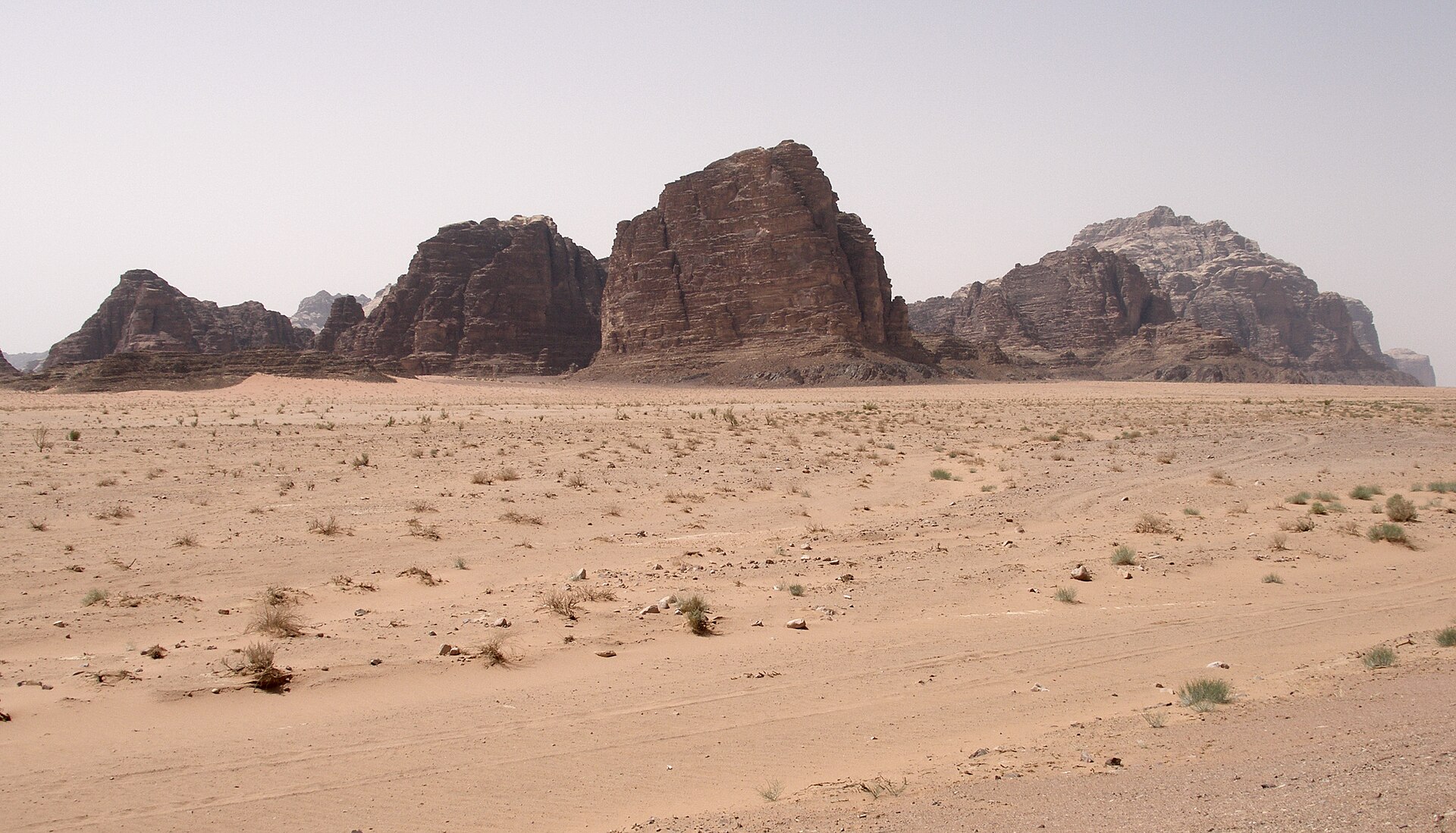
Day 6, Wadi Rum. Under two hours from Petra. Arrive by early afternoon, take a 4x4 route out into the reserve, and stay at a camp. The protected area covers roughly 720 square kilometres and rises from about 45 m to 1,750 m, so what you see depends on where your operator takes you. Mean daily highs run around 34.6°C in July and mean daily lows around 4.6°C in January, on about 74 mm of rain a year. The nights are cold in a way the daytime does not prepare you for.
Day 7, out. Aqaba is about an hour from Rum. Fly home from King Hussein International, or connect to Amman in about an hour in the air if your long-haul leaves Queen Alia.
What actually needs booking ahead
Jordan is mostly a turn-up country. The exceptions are short: the Jordan Pass, before you fly, because the waiver depends on it; your Wadi Rum camp and 4x4, because the operator, the vehicle and the bed are one arrangement and the good ones fill; and Petra by Night by asking rather than booking, since it is not on a fixed schedule. Petra itself needs nothing booked if you hold the pass. Scan it at the Visitor Centre and walk in.
Two costs that are not on the pass catch people out. Nature reserves are a separate system: Dana, Mujib, Ajloun Woodland and Azraq sit outside it and add 16% tax on top of their listed fees, with the Mujib Siq Trail at 21 JD for foreigners before tax and the harder routes considerably more. The Dead Sea is not a site, it is a ticket: beach access comes through a hotel or the public beach, at a price that varies by where you go, and it is not on the pass attractions list.
Key Takeaways
| Point | Details |
|---|---|
| The pass saves 20 JD at every tier, before any other site | Wanderer 70 against 90, Explorer 75 against 95, Expert 80 against 100, counting only the visa and Petra. |
| A second Petra day costs 5 JD | The gap between the Wanderer and Explorer tiers. The best value decision on the trip. |
| Buy before arrival, print it, and pick the tier once | The waiver depends on advance purchase, the pass site warns the QR may not scan from a phone, and there are no upgrades or downgrades afterwards. |
| The minimum stay is disputed | The pass site says two nights (3 days). The UK Foreign Office and a Jordanian MFA document both say three. Plan for three. |
| Arriving via Aqaba can make the pass marginal | The ASEZA free visa removes the 40 JD the pass is mostly saving you. |
| Petra publishes 25 trails | 1.5 km to 18.8 km. The Main Trail is 3.9 km. One day sees a fraction of the site. |
| Winter hours are 06:30 to 17:00 | Not the 06:00 to 16:00 many guides still print. Summer is 06:00 to 18:00. |
| Petra by Night is 30 JD and currently paused | Price rose from 17 JD on 1 May 2025. The operator said on 29 April 2026 that it runs by arrangement, not on a schedule. |
| Petra is not a day trip from Amman | Return minibuses leave Petra only between 06:00 and 13:00. The JETT coach gives you about six hours. |
| Nature reserves and the Dead Sea are not on the pass | Dana and Mujib are a separate system with 16% tax on top. Beach access is its own ticket. |
Where this plan breaks
One night in Wadi Rum is the compromise nearly everyone makes, and it is right only if you accept what it is. You arrive mid afternoon, ride out, eat, sleep and leave after breakfast: one sunset and one sunrise. Two nights turns the desert into a place rather than a stop, and the day has to come from somewhere. Take it from Amman, not from Petra.
Summer is a scheduling constraint, not a packing note. Petra has almost no shade on the Main Trail and none at all on the climbs, and Wadi Rum has less. In July and August the workable hours are the first three after opening and the last two before closing, which is another argument for two Petra days rather than one long one. A plan that has you climbing to the Monastery at 13:00 in August has not been thought about. Winter has the opposite problem: a 17:00 close takes ninety minutes off the afternoon, so a late start costs you the descent from Ad Deir in daylight.
Seven days assumes one long-haul flight, not two connections. Lose half a day at each end and something has to go. Cut the King's Highway first, then the second Amman night. Do not cut the second Petra day, which is the whole reason the plan is shaped like this.
The pass covers entry, not access. It gets you through the gate at more than forty sites. It does not cover the 4x4 in Wadi Rum, the guide required on Petra's back trails, the horse or cart inside Petra, Petra by Night, the Baptism Site (an 8 JD add-on at purchase against 12 at the gate), the nature reserves, or any transport. Budget those separately or the pass will feel like it under-delivered when the fault is the expectation.
How Planytera handles a trip like this
Planytera is an AI trip planner built by a solo developer, available on iOS, Android and the web. You describe the trip and it produces a day-by-day itinerary, ready in moments. On a trip like Jordan, three things do most of the work.
Multi-stop pacing. Three bases in seven days, with one transfer of three hours and another that is either two hours or a whole day depending on which road you take, is a plan whose quality lives entirely in the pacing. Setting the pace once and letting the days redistribute when a night moves beats rewriting the whole grid because you decided to take the King's Highway.
Re-pacing without starting over. Jordan has fewer moving parts than an island-hopping trip, but the ones that move matter: a Petra by Night that is not running, a King's Highway day that overran, an extra night in Wadi Rum. Adjusting one day and keeping the rest in sync is the difference between an itinerary and a document you stop opening on day three.
Shared plans and split costs. Jordan is a common small-group trip and the costs land unevenly: one person buys the passes, another pays the camp deposit, a third covers the driver. Share a read-only link so everyone has the same plan, let people vote on activities, and let split costs track who owes who. It does the arithmetic and never touches anyone's money.
Frequently asked questions
Is the Jordan Pass worth it?
For most visitors flying into Amman, yes, and the margin is easy to check. Against the 40 JD single entry visa plus Petra's own 50, 55 or 60 JD ticket, every tier comes out exactly 20 JD cheaper before you enter anything else, and a normal week adds another 25 to 30 JD of sites like Jerash, Wadi Rum and the Amman Citadel. It is worth much less if you arrive and leave through Aqaba, where the visa is free anyway, and it is not sold to Arab nationality holders at all.
Which Jordan Pass should I buy?
The Jordan Explorer, at 75 JD, unless you have a specific reason not to. It is five dinars more than the Wanderer and buys a second consecutive day at Petra, which is the difference between seeing the Treasury and seeing the site. The Expert at 80 JD adds a third Petra day and earns it if you intend to hike the longer trails. You cannot change tier after purchase, so decide before you pay.
How many days do you need in Petra?
Two, for anybody who has travelled to Jordan for Petra. The site publishes twenty-five marked trails from 1.5 km to 18.8 km, and the Main Trail everybody walks is 3.9 km of that. One day gets you the Siq, the Treasury and a hurried climb to the Monastery, in the middle of the day, with everyone else. Two days lets you take the Main Trail and Ad Deir at opening on day one, then the high ground and the Royal Tombs on day two.
What time does Petra open and close?
06:00 to 18:00 in the summer season, published as 2 March to 1 October, and 06:30 to 17:00 in winter, from 2 October to 1 March. Many guides still print 06:00 to 16:00 for winter and the official site says otherwise. Little Petra's ticket office keeps shorter hours again, 07:00 to 16:00 in summer and 07:00 to 14:00 in winter. The park asks visitors to be out before sunset and does not allow overnight stays inside.
Is Petra by Night included in the Jordan Pass?
No. The pass FAQ states it is not included in any package, and the pass covers Petra during the day only. The ticket is 30 JD per person, up from 17 JD on 1 May 2025, with under 10s free, sold on site at the Petra Visitor Centre kiosk. More importantly, the operator announced on 29 April 2026 that the programme is paused and no longer runs on a fixed schedule, so contact them directly rather than assuming a Sunday to Thursday night will run.
Can you visit Petra as a day trip from Amman?
Not well. Petra is around 240 km south of Amman, about three hours each way on the Desert Highway. The JETT coach leaves Abdali at 06:30 and returns from Petra at 17:00, giving you roughly six hours on a site whose main walking route is 7.8 km round trip. Public minibuses are worse: the last return leaves Petra at 13:00. Stay two nights in Wadi Musa and buy the tier that gives you two Petra days.
Useful sources and further reading
- Jordan Pass, run by the Ministry of Tourism and Antiquities: tier prices and the FAQ covering the waiver, single entry per site, the Petra by Night exclusion and the Wadi Araba border rule.
- Visit Petra: fees and opening hours, the site authority's own prices and seasonal times.
- Visit Petra: trails, the twenty-five marked routes with distances and grades.
- Visit Petra: getting to Petra, for the JETT and minibus timings and the drives from Amman.
- Petra by Night, for the 30 JD price from 1 May 2025 and the 29 April 2026 notice that operations are paused.
- Jordan Tourism Board entrance fees, the official schedule for Jerash, the Citadel, Wadi Rum, the castles and the nature reserves.
- UK government travel advice for Jordan, for the 40 JD visa, the three night reading, passport validity and the 10 JD land border departure tax.
- Jordan Trail Association: arriving in Jordan, for the Aqaba ASEZA free visa and the crossings where visa on arrival is not available.
Recommended
More from the Planytera blog.