Blog18 min read
10 Days in Egypt: Cruise or Land, and What the Ticket Covers
A ten day Egypt plan from the ministry's own ticket portal: what the headline entry price really admits you to, and how a Nile cruise fixes your week.
By Dom

Two decisions make or break ten days in Egypt, and neither is the one people argue about.
The first is that Egyptian site tickets are area tickets. The published price gets you inside the fence. The specific thing you flew here to stand in front of is very often a separate ticket at a price that can be more than double the entry fee. That is not hidden. It is printed on the Ministry of Tourism and Antiquities' own booking portal, in a panel most people never open because they book through an agent.
The second is that a Nile cruise is a scheduled service with fixed weekly departures, not a hotel that floats. The moment you book one it decides which day of the week you land in Cairo, how long you get in Luxor, and whether Abu Simbel is possible at all. Cruise or land is a scheduling decision first and a comfort decision second.
This is a ten day plan built from those two facts, using the ministry's published prices and hours, and calling out where two official Egyptian government sites give two different answers.
The entry ticket is a fence ticket
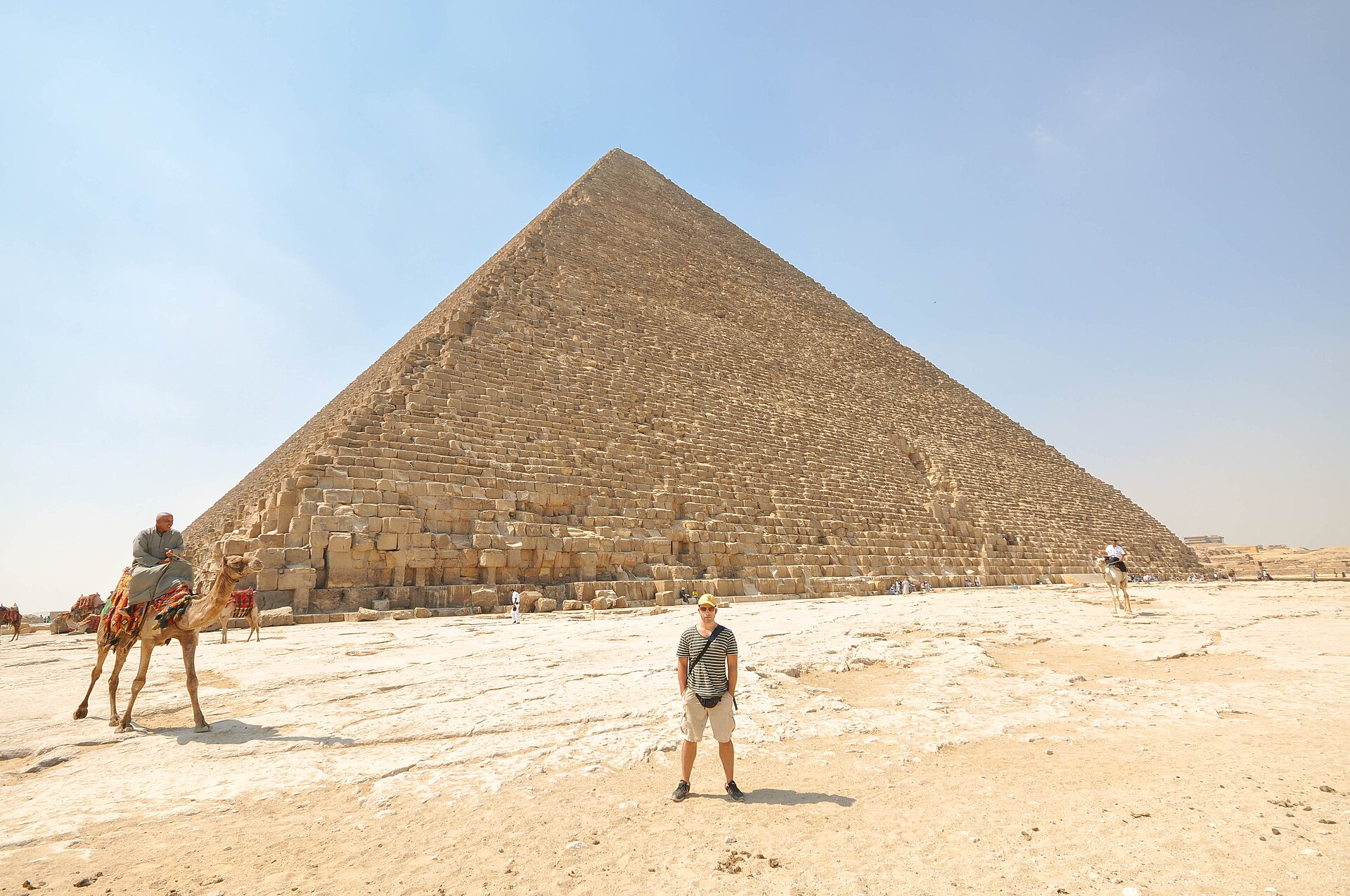
Start at Giza, the clearest case. The ministry sells plateau tickets through its own portal at egymonuments.com. Here is what that checkout actually offers a foreign adult.
| Giza ticket | Foreign adult | Foreign student |
|---|---|---|
| Area entry | EGP 700 | EGP 350 |
| Khufu Pyramid, inside | EGP 1,500 | EGP 750 |
| Menkaure Pyramid, inside | EGP 280 | EGP 140 |
| Meresankh III tomb | EGP 200 | EGP 100 |
| Workers' cemetery, minimum 5 tickets | EGP 700 | EGP 350 |
Read the second row again. Going inside the Great Pyramid costs more than twice the price of getting onto the plateau at all. The ministry's descriptive site says the same thing in words: the area ticket "does not cover the Great Pyramid, Pyramid of Khafre, Pyramid of Menkaure, Tomb of Meresankh III, Worker's Cemetery." Note what is missing from the online list too. Khafre's pyramid is not sold as an add-on through the portal at all, so that one you buy at the gate.

The Valley of the Kings does the same thing, harder
| Valley of the Kings ticket | Foreign adult | Foreign student |
|---|---|---|
| Site entry | EGP 750 | EGP 375 |
| Tomb of Tutankhamun | EGP 700 | EGP 350 |
| Tomb of Seti I | EGP 2,000 | EGP 2,000 |
| Tomb of Ramesses V and VI | EGP 220 | EGP 110 |
| Tomb of Ay | EGP 200 | EGP 100 |
Two things stand out. Seti I costs nearly three times the site entry, and it is the one tomb where the student price matches the adult price, so the usual half-price rate does not apply. And Tutankhamun is almost the price of the site again, worth knowing before you commit to a small, plain tomb with a famous name.
Neither official source states how many tombs the EGP 750 entry admits you to, or which are open on the day. That rotates. Choose add-ons at the ticket office, not in advance.
Saqqara sells an inclusive ticket that is not inclusive
Saqqara is the third variation. Area entry is EGP 600 and there is an "all-inclusive" ticket at EGP 1,400, and the ministry spells out what that covers: the site, the Imhotep Museum, the Nobles' Tombs, the New Kingdom tombs, and the tombs of Mereruka and Mehu. The Step Pyramid interior at EGP 280 and the Serapeum at EGP 340 are not in that list, and they are the two things most people now go to Saqqara for. Add both and you are at EGP 2,020.
Where the official sources disagree with each other
This is not a case of blogs being sloppy. Egypt runs two government sites, and they do not always match.
Abu Simbel. The descriptive site, egymonuments.gov.eg, lists a foreign adult at EGP 750, rising to EGP 1,200 on 22 February and 22 October for the sun alignment. The booking portal sells the same tickets at EGP 822 and EGP 1,272. The gap is EGP 72 on both, which reads like a booking fee only the checkout knows about. Every other site I checked matched to the pound across both systems.
Giza opening hours. The descriptive site says 08:00 to 16:00 daily. The portal says gates from 07:00 with last entry at 16:00, and 08:00 with last entry 15:30 during Ramadan. Turning up at 07:00 on the strength of the second one is a risk. Turning up at 08:00 is not.
The Grand Egyptian Museum. GEM publishes no price on visit-gem.com outside its booking flow, which is the most frustrating thing about planning a Cairo day. Egypt Independent published the official list on 1 November 2025 at EGP 1,700 for foreign adults and EGP 850 for foreign students and children. Guides through 2026 quote EGP 1,450. Separately, the ministry announced a rise from 1 November 2026: Egyptian adults EGP 200 to EGP 220, Egyptian students and seniors EGP 100 to EGP 120, and five dollars more for international visitors. Those cannot all describe the same ticket. Budget between EGP 1,450 and EGP 1,700, book on visit-gem.com, and treat any other figure as decoration.
Two GEM facts are not in dispute. Tickets are timed and sold on the official site only. And the hours are unusual: the complex runs 08:30 to 19:00 with galleries 09:00 to 18:00 most days, but on Wednesday and Saturday the complex stays open to 22:00 and galleries to 21:00, last entry an hour before. If your Cairo days are flexible, put GEM on one of those two and you gain three hours.
The cruise decides your days of the week
Nile cruise ships do not run daily. Sonesta, one of the larger operators, publishes exactly four patterns on its own site: four nights Luxor to Aswan departing Mondays, three nights Aswan to Luxor departing Fridays, and seven night round trips from each end on the same two days. Other fleets differ in the details, but the shape is universal: fixed weekly sailings, in one of two directions.
The four night Luxor to Aswan run gives Luxor two days, and one is arrival day. Sonesta's published day-by-day is Karnak and Luxor Temple on the Monday you board, the West Bank on Tuesday, Edfu and Kom Ombo on Wednesday, Aswan on Thursday, disembark Friday. Karnak on a jet-lagged arrival afternoon is a real cost.
The three night Aswan to Luxor run gives Luxor one day at the very end, with a morning disembarkation behind it. If Luxor is the reason you came, that direction is the wrong one.
Neither direction includes Abu Simbel. It sits about 214 km south of Aswan by air and is not on the Luxor to Aswan corridor. You add it as a separate day: by road before dawn, or on one of the roughly five weekly EgyptAir and Air Cairo flights, about 45 minutes each way.
If you are looking at a dahabiya, the small sail-driven boats, check the boarding point before you book a Luxor hotel. Nour El Nil boards at Esna, which its own site puts 33 miles south of Luxor, and runs five nights and 250 km up to Aswan. Several dahabiya operators do the same, because the Esna lock is awkward for a boat that size.
What the cruise fare covers, and the number to compare it against
Operators vary, and this is the question to ask in writing before you pay. Sonesta's itinerary page lists meals and onboard entertainment and does not state whether site entrance fees are in the fare. Nour El Nil says rates "cover all expenses and services". Some fleets include every ticket, some none, and some the temples but not the Valley of the Kings add-ons.
So price the alternative. Here is what the standard four night Luxor to Aswan route costs at the gate, foreign adult, at the ministry's published prices.
| Site on the standard cruise route | Foreign adult |
|---|---|
| Karnak, including the Open Air Museum | EGP 600 |
| Luxor Temple | EGP 500 |
| Valley of the Kings, entry only | EGP 750 |
| Valley of the Queens | EGP 220 |
| Hatshepsut, Deir el Bahari | EGP 440 |
| Edfu, Temple of Horus | EGP 550 |
| Kom Ombo | EGP 450 |
| Philae | EGP 550 |
| Total | EGP 4,060 |
That is entry only. It excludes the High Dam, the Unfinished Obelisk at EGP 220, every Valley of the Kings tomb add-on and the Philae panorama at EGP 200. A cruise sold as "all inclusive" that turns out to exclude entrance fees is roughly four thousand pounds per person light, before anybody picks a tomb.

Cruise or land: the honest comparison
Take the cruise if you want Edfu and Kom Ombo without organising two road transfers, you like the sites being a short walk from your bed, and you can build the trip around a Monday or a Friday. Luxor to Aswan is the better direction for a first visit.
Stay on land if Luxor is the point. A Luxor base gives you the West Bank across two mornings instead of one, Luxor Temple in the evening when it is lit and cool (it is the only major site open to 20:00), and the freedom to sit out a 41°C afternoon. Edfu and Kom Ombo then become a long road day on the way to Aswan, or you skip them, which is a legitimate choice nobody makes out loud.
Take a dahabiya if the boat itself is the holiday, you have six days for it, and you accept boarding at Esna.
Getting between Cairo and the south
Cairo to Luxor is 510 km, and the choice is really about which night you are willing to spend moving.
| Option | Time | Notes |
|---|---|---|
| Fly, Cairo to Luxor | about 1 hour | Around 31 flights a week across five carriers |
| Fly, Cairo to Aswan | about 1h30 | Multiple daily departures |
| Sleeper train 86, Cairo to Aswan | 21:00 to 08:15 | Run by Abela, calls at Luxor |
| Sleeper train 87, Aswan to Cairo | 20:30 to 07:25 | The northbound working |
| Daytime express, Cairo to Luxor | about 9h30 | Train 2010, 10:00 from Ramses |
| Fly, Aswan to Abu Simbel | about 45 min | Roughly five flights a week, EgyptAir and Air Cairo |
Two notes on the train. Since December 2022 non-Egyptians pay separate foreigner fares priced in US dollars, so a figure you read in Egyptian pounds is not what you will be quoted. And the sleeper is now run by Abela rather than the national railway, which is why the old Watania booking site redirects.
Southbound it is good value on time, converting a travel day into a travel night and dropping you into Aswan at breakfast. Northbound it is a poor idea if you have a morning flight out of Cairo, because a 07:25 arrival with no slack is not a connection.
Heat is a scheduling input, not a packing note
The Egyptian Meteorological Authority's climate normals, published through the WMO, put Luxor's mean daily maximum at 41.4°C in July, and Aswan's at exactly the same figure. June and August are within half a degree.
| Month | Luxor mean max | Luxor mean min | Aswan mean max |
|---|---|---|---|
| January | 23.0°C | 5.9°C | 22.9°C |
| March | 29.5°C | 11.8°C | 29.4°C |
| May | 39.0°C | 21.2°C | 39.0°C |
| July | 41.4°C | 24.7°C | 41.4°C |
| October | 35.3°C | 18.4°C | 35.7°C |
Rainfall is effectively zero all year in both, so weather is not a cancellation risk the way it is in Iceland or Patagonia. It is a working-hours risk. In summer the usable window at an unshaded site is the first three hours after opening, which is why every site in the Nile valley opens at 06:00 or 07:00. Note the January minimum too: 5.9°C at dawn in Luxor is cold on an open sun deck, colder in a balloon basket. Winter is high season for good reason, and it is when the capped tickets go first.
The ten days
This is the cruise version, built around a Monday sailing. Fly in on a Saturday, out on a Monday.
| Night | Base | The move that shapes the day |
|---|---|---|
| 1 | Cairo | Arrival |
| 2 | Cairo | Giza and GEM |
| 3 | Cairo | Saqqara, Dahshur, the Egyptian Museum |
| 4 | Luxor | Fly down, board the ship Monday |
| 5 | on board | West Bank, sail to Esna |
| 6 | on board | Edfu and Kom Ombo |
| 7 | on board | Aswan |
| 8 | Aswan | Disembark, Philae and the Nubia Museum |
| 9 | Aswan | Abu Simbel |
| 10 | Cairo | Fly north, night flight out |
Days 1 to 3, Cairo. Giza and GEM are next door and both half-day sites, so they pair. Put that pair on a Wednesday or Saturday for GEM's late hours. Saqqara and Dahshur are the other direction and pair with each other, EGP 600 and EGP 200, both 08:00 to 16:00. The Egyptian Museum on Tahrir is EGP 550 and still worth a half day now that Tutankhamun has moved, 09:00 with last entry at 16:00.
Day 4, go south and board. An hour in the air beats nine and a half on a train if the ship sails that afternoon. Karnak, EGP 600 and open 06:00 to 17:00, is the day's real work.
Days 5 to 7, on the river. Protect the West Bank morning: Valley of the Kings entry at EGP 750 plus whichever add-on you pick, then Hatshepsut at EGP 440 and the Valley of the Queens at EGP 220. Go at opening.
Day 8, Aswan. Philae is EGP 550 with last entry at 15:00, earlier than people expect and easy to miss on a disembarkation day. The Nubia Museum is EGP 400 and opens again 18:00 to 20:00 on Thursdays and Fridays.
Day 9, Abu Simbel. The pre-dawn road run or the short flight. By road you are back in Aswan by early afternoon with the day gone. If your dates fall on 22 February or 22 October, the sun alignment ticket is EGP 1,200 on the ministry site and EGP 1,272 on the portal, and everything that day is busier.
Day 10, out. Aswan to Cairo is about an hour and a half, then the long haul.
The land version
Same Cairo block. Then fly to Luxor for four nights instead of one, take the West Bank across two mornings, do Luxor Temple in the evening, and drive to Aswan on the fifth day with Edfu and Kom Ombo as stops. Three nights in Aswan covers Philae, Abu Simbel and a felucca afternoon. You lose the river and gain two working mornings in the best archaeological landscape in the country.
What actually needs booking ahead
Short list. GEM, because entry is timed and sold on the official site only. The cruise, because there is one sailing a week in your direction. Domestic flights, because Cairo to Luxor is busy and Aswan to Abu Simbel runs about five times a week. The Khufu interior ticket, which is capped daily.
Everything else you buy on the day. Two points from the ministry's FAQ: Visa and Mastercard are accepted across all channels, including on-site counters and self-service kiosks, and tickets are non-refundable and cannot be replaced if lost, so pick your date carefully. Phone photography is free. Drones are heavily restricted without a Ministry of Defence permit, which in practice means leave it at home.
On the visa: a single-entry visa on arrival is USD 30, cash, per UK government advice, and from 1 August 2026 Cairo Airport also sells a digital visa at self-service machines for USD 36, the 30 plus a six dollar service fee, by card. Airport agents charge more than the official rate and are not necessary.
Key Takeaways
| Point | Details |
|---|---|
| The entry ticket is a fence ticket | Giza plateau entry is EGP 700. Inside the Great Pyramid is a separate EGP 1,500. |
| Seti I costs more than the valley | Valley of the Kings entry EGP 750, Seti I add-on EGP 2,000, and the student price is the same as the adult price. |
| Saqqara's "all-inclusive" is not | EGP 1,400 covers the site, Imhotep Museum and several tombs. The Step Pyramid interior and the Serapeum are EGP 280 and EGP 340 on top. |
| Two official sites, two Abu Simbel prices | EGP 750 on egymonuments.gov.eg, EGP 822 on the booking portal. A flat EGP 72 gap that appears at checkout. |
| The cruise fixes your calendar | Sonesta sails four nights Luxor to Aswan on Mondays and three nights Aswan to Luxor on Fridays. |
| Entry fees on the cruise route total EGP 4,060 | Eight sites, foreign adult, entry only, before any tomb add-on. Ask in writing whether the fare includes them. |
| Abu Simbel is never on the cruise | About 214 km south of Aswan. Roughly five flights a week, about 45 minutes, or a pre-dawn road run. |
| GEM's late nights are Wednesday and Saturday | Galleries to 21:00 instead of 18:00, last entry one hour before. |
| Luxor and Aswan average 41.4°C in July | Egyptian Meteorological Authority normals. The usable window is the first hours after opening. |
Where this plan breaks
Three Cairo nights is the minimum and it is tight. Giza with the Khufu interior, GEM, Saqqara, Dahshur and the Egyptian Museum is five substantial half-days squeezed into two and a half. Something goes. Cut Dahshur first, then the Citadel if you had it in, and never cut GEM, because it is the reason the Cairo block is shaped this way.
The cruise arrival day is weaker than it looks on paper. You land in Luxor, transfer, board, and are taken to Karnak in the afternoon heat on the day you flew. If the flight slips, Karnak is what you lose, and the ship sails regardless. A land-based Luxor block has no such failure mode, which is the strongest single argument for it.
Abu Simbel by road eats a day. The pre-dawn departure and the checkpoints are real, the drive is long both ways, and the temples themselves need about ninety minutes. Flying converts it into a morning. If no flight runs on your date, decide whether the day is worth it before you build the trip around it.
The prices here will move, and Ramadan moves the hours. Egyptian site fees have been revised repeatedly and GEM has a rise scheduled for 1 November 2026. Everything above came off official Egyptian government pages in August 2026, which is exactly as durable as that sounds. The portal also publishes a separate Ramadan column for every site, generally shorter. Check both before you budget or set an alarm.
How Planytera handles a trip like this
Planytera is an AI trip planner built by a solo developer, available on iOS, Android and the web. You describe the trip and it produces a day-by-day itinerary, ready in moments. On a trip shaped like this one, four things do most of the work.
Multi-stop pacing around a fixed date. A Monday sailing is an immovable object with nine days arranged around it. Setting the pace once and letting the Cairo and Aswan blocks redistribute around that anchor beats rebuilding a grid every time a flight moves.
Re-pacing without starting over. Egypt is full of small reschedules: a GEM slot that only works on a Wednesday, an Abu Simbel flight that runs five days a week not seven, a West Bank morning that has to start at opening. Moving one day and keeping the rest in sync is the difference between an itinerary and a document you stop opening on day three.
Per-person cost estimates and split costs. On this trip the ticket arithmetic is the budget, spread across a dozen small purchases in one currency plus a cruise fare in another. Seeing the per-person figure before committing helps, and split costs then tracks who owes who without anyone keeping a spreadsheet and without moving anyone's money.
Frequently asked questions
Is a Nile cruise better than staying on land in Egypt?
It depends on whether Luxor or the river is the point. A cruise handles Edfu and Kom Ombo without two road transfers, but it runs on fixed weekly sailings, and the four night Luxor to Aswan version gives Luxor two days, one of them your arrival day. Staying on land in Luxor buys two West Bank mornings, Luxor Temple in the evening, and the ability to sit out the heat. Neither option includes Abu Simbel.
How much does it cost to go inside the Great Pyramid?
EGP 1,500 for a foreign adult and EGP 750 for a foreign student, on top of the EGP 700 plateau entry, on the ministry's own booking portal. Third-party guides currently quote EGP 400, EGP 1,000 and EGP 1,500 for the same ticket, which is why the official checkout is the only number worth using. Daily numbers are capped, so buy in advance rather than at the gate.
Does the Valley of the Kings ticket include the tomb of Tutankhamun?
No. Site entry is EGP 750 for a foreign adult and admits you to a rotating set of open tombs. Tutankhamun is a separate EGP 700, Seti I is EGP 2,000, Ramesses V and VI EGP 220 and Ay EGP 200. Neither official source says how many tombs the base ticket covers or which are open on a given day, so ask at the ticket office and decide there.
How much are Grand Egyptian Museum tickets?
The museum publishes no price outside its booking flow and the sources disagree. Egypt Independent's official list of 1 November 2025 gives EGP 1,700 for foreign adults and EGP 850 for students and children; guides through 2026 quote EGP 1,450. A further rise takes effect on 1 November 2026, five dollars more for international visitors. Budget in that range, book on visit-gem.com, and prefer a Wednesday or Saturday when galleries stay open to 21:00.
How do you get from Cairo to Luxor?
Flying is about an hour, with roughly 31 services a week across five carriers over the 510 km. The Abela sleeper, train 86, leaves Cairo at 21:00 and reaches Aswan at 08:15, calling at Luxor. The daytime express takes about nine and a half hours. Since December 2022 non-Egyptians pay separate foreigner fares on the trains, priced in US dollars.
When is the best time to visit Egypt?
November to March, on the numbers. Luxor and Aswan both average a mean daily maximum of 41.4°C in July against 23°C in January, and rainfall is negligible year round, so the constraint is heat rather than weather. Winter mornings are genuinely cold, with a Luxor mean minimum of 5.9°C in January, which matters for a dawn balloon or an open sun deck.
Useful sources and further reading
- Ministry of Tourism and Antiquities: Discover Egypt's Monuments, for published fee lists and hours at Giza, Saqqara, the Valley of the Kings, Karnak and Abu Simbel.
- egymonuments.com, the ministry's ticket portal, for the add-on prices at Giza, the Valley of the Kings and Saqqara, and its FAQ on payment, refunds and drones.
- Grand Egyptian Museum official ticketing, for opening hours, the Wednesday and Saturday late nights and the concession list.
- Egypt Independent on the GEM price list and on the rise from 1 November 2026.
- Sonesta Moon Goddess itineraries for sailing days and the day-by-day route, and the Nour El Nil itinerary for the Esna boarding point.
- UK government travel advice for Egypt, for the USD 30 visa on arrival, the USD 36 digital visa from 1 August 2026 and passport validity.
- The Man in Seat 61: Egypt, for sleeper train numbers, timings and the foreigner fare rule.
- WMO World Weather Information Service, carrying the Egyptian Meteorological Authority's climate normals for Luxor and Aswan.
- FlightConnections, for weekly frequencies and durations on Cairo to Luxor and Aswan to Abu Simbel.
Recommended
More from the Planytera blog.